Z-Image Turbo vs FLUX 3 klein: 5 real tests on a 16 GB RTX 5080
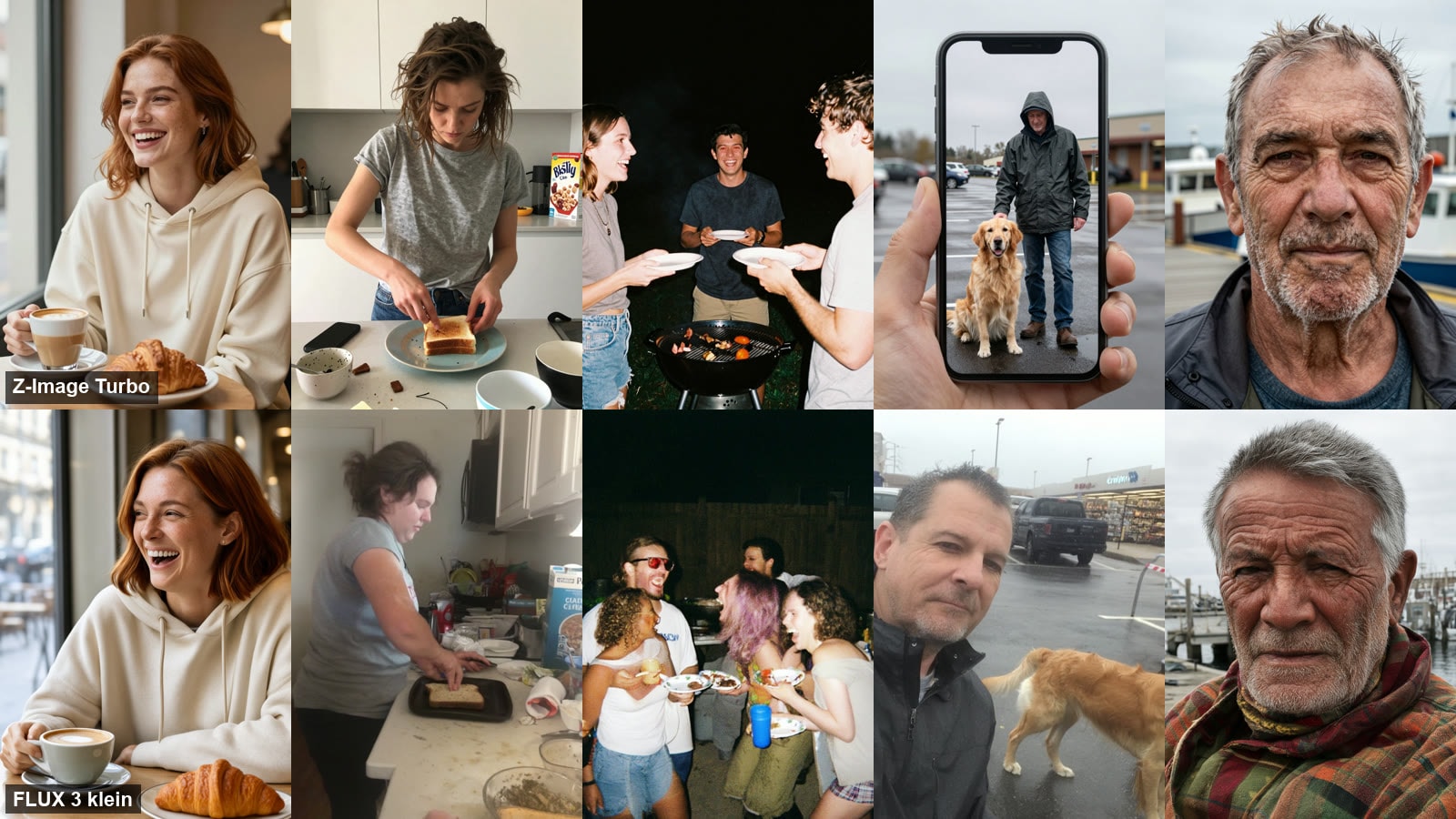
Same prompts, same seeds, run locally in ComfyUI. Z-Image Turbo wins polished portraits and speed; FLUX 3 klein wins believable amateur snapshots.
October 30, 2026Short answer: Use Z-Image Turbo when you want clean, polished, professional-looking people, and when speed matters (about 9 seconds an image on our machine). Use FLUX 3 klein when you want a photo to look like a real, unflattering snapshot from someone's phone. Neither one wins everything.
Pick this if...
| You want | Pick | Why |
|---|---|---|
| Polished portraits, lifestyle, "professional photo" | Z-Image Turbo | Crisp skin texture, clean light, very natural faces |
| Believable amateur / phone snapshots | FLUX 3 klein | Messier scenes, awkward framing, real-life imperfections |
| Speed and fast iteration | Z-Image Turbo | ~9 s per image vs ~26 s |
| Close-up skin detail | Z-Image Turbo (slightly) | Pores and wrinkles are very sharp |
How we tested
- Hardware: RTX 5080 (16 GB VRAM), 32 GB RAM, Windows 11, ComfyUI.
- Models:
z_image_turbo_bf16(Z-Image Turbo, 6B) andflux3-image-klein-base-bf16(FLUX 3 klein base). Full-precision files, no LoRAs. - Settings: each model at its recommended settings. Z-Image Turbo: 8 steps, CFG 1,
res_multistep, shift 3, no negative prompt. FLUX 3 klein: 30 steps, CFG 3.5,euler, empty negative. - Fairness: same prompt and same seed for both models, 832×1040 (4:5). Every image is a one-shot: first seed only, no re-rolls, no cherry-picking, no inpainting or upscaling, and no negative prompt on either model.
- Tested: October 30, 2026.
The 5 tests
1. Cafe portrait (polished)
professional lifestyle photograph of a woman in her early thirties with auburn shoulder-length hair and light freckles, laughing at a cafe table with a latte and a croissant, oversized cream hoodie, soft natural window light, sharp focus
Both are strong. Z-Image is crisper, with sharper freckles and a cleaner, brighter look. FLUX is warmer and softer and feels a little more candid, but look closely at the eyes: they're slightly off, with an uneven squint, and the hoodie is spotless and perfectly smooth, which reads as styled rather than candid. Slight edge: Z-Image, whose face holds up better.
2. Kitchen snapshot (amateur)
amateur phone photo, a woman in her thirties with messy hair in a grey t-shirt making toast at a cluttered kitchen counter in the morning, taken with an old iPhone, flat indoor light, slightly off-center, a little motion blur, dirty dishes and cereal box in the background, unedited
Z-Image still produces a tidy, bright, styled kitchen. It looks like a magazine shot of "a messy morning". FLUX gives a genuinely cluttered counter, an awkward pose and flat light. The mood is much closer to a real photo, but look at the arm: the forearm reaching over the toast bends oddly and the other hand has turned into a blur with a knife-like shape. That's a visible anatomy glitch, and Z-Image's tidy version has its own: garbled cereal-box text and awkward fingers on the toast. Winner: FLUX on atmosphere, with a caveat. Run a few seeds before trusting its hands.
3. Backyard barbecue with harsh flash (amateur)
candid phone photo at night with harsh direct flash, three friends laughing at a backyard barbecue holding paper plates, red eyes, dark background, slightly overexposed faces, unedited snapshot
Z-Image nails the flash-and-black-background look, but the group is neatly arranged around a centered grill. FLUX is chaotic, crowded and blown out, which is the feel of a real party photo. The crowd is also where it breaks down: the bearded man's arm passes straight through the woman in front of him, and the limbs in the pile on the right are hard to untangle. Z-Image's three people are clean, with no merged bodies. Winner: FLUX on look, Z-Image on anatomy.
4. Man and dog in a parking lot (amateur)
phone snapshot of a middle-aged man in a rain jacket with his golden retriever in a supermarket parking lot on an overcast day, off-center framing, slightly crooked horizon, ordinary and unposed
Z-Image took "phone snapshot" literally and drew a hand holding a phone with the scene on its screen. FLUX produced a believable candid selfie with the dog wandering past. Winner: FLUX, plus a prompt lesson (below).
5. Fisherman close-up (polished)
close-up portrait of a 70 year old fisherman with a weathered face and grey stubble on a harbor dock, overcast daylight, natural skin texture, 85mm photo
Both are excellent. Z-Image has extremely sharp pores and wrinkles. Up close, the texture is almost overdone. FLUX is slightly more stylized, with a nice scarf and harbor detail. Slight edge: Z-Image.
Speed (measured, warm model)
| Model | Steps | Seconds per image (832×1040) |
|---|---|---|
| Z-Image Turbo | 8 | ~9–10 s |
| FLUX 3 klein (base) | 30 | ~26 s |
Times are from ComfyUI's own execution log on the RTX 5080, with the model already loaded. File sizes: Z-Image Turbo 11.5 GB (+5.2 GB fp8 text encoder), FLUX 3 klein base 10.3 GB (+8.3 GB text encoder). Both ran fine on 16 GB. We did not measure peak VRAM.
Prompt tips we learned
- Z-Image Turbo: don't write "phone photo" or "phone snapshot". It may draw a phone. Describe the qualities instead: harsh on-camera flash, slight motion blur, crooked framing, cluttered background, unedited.
- Z-Image Turbo leans polished even when you ask for amateur. Pile on the imperfections, or try the non-Turbo Z-Image base, which accepts a negative prompt (for example studio lighting, retouched, model pose). That's our next test.
- FLUX 3 klein follows "amateur" wording well. Its plainness, a weakness for glamour shots, is a strength for real-life scenes.
Licenses
- Z-Image Turbo: Apache 2.0 (model card), commercial use allowed.
- FLUX 3 klein: the FLUX Kommunity License v1.0. Per the model card, non-commercial use is free, generating images commercially is allowed for users under US$5M in annual revenue, and anything else needs a separate license. Read the license yourself before commercial use.
FAQ
Does Z-Image Turbo run on a 16 GB GPU? Yes. The full bf16 model ran comfortably on our 16 GB RTX 5080 at about 9 seconds an image.
Which is better for realistic people? For polished, professional-looking people, Z-Image Turbo. For believable everyday snapshots, FLUX 3 klein.
Which is faster? Z-Image Turbo, by about 2.5–3 times in our tests.
Tested and written October 30, 2026. Next up: Z-Image Turbo vs Z-Image base, and whether the base model's negative prompt fixes the "too polished" problem.