
Ask your stakeholders before the meeting.
Proxies are simulated personas you test an idea on. Each one has a role, goals, and hard lines. You show them a flow, a spec, or a prototype, and each one tells you where it breaks for them.
Find the problems before the real meeting does.
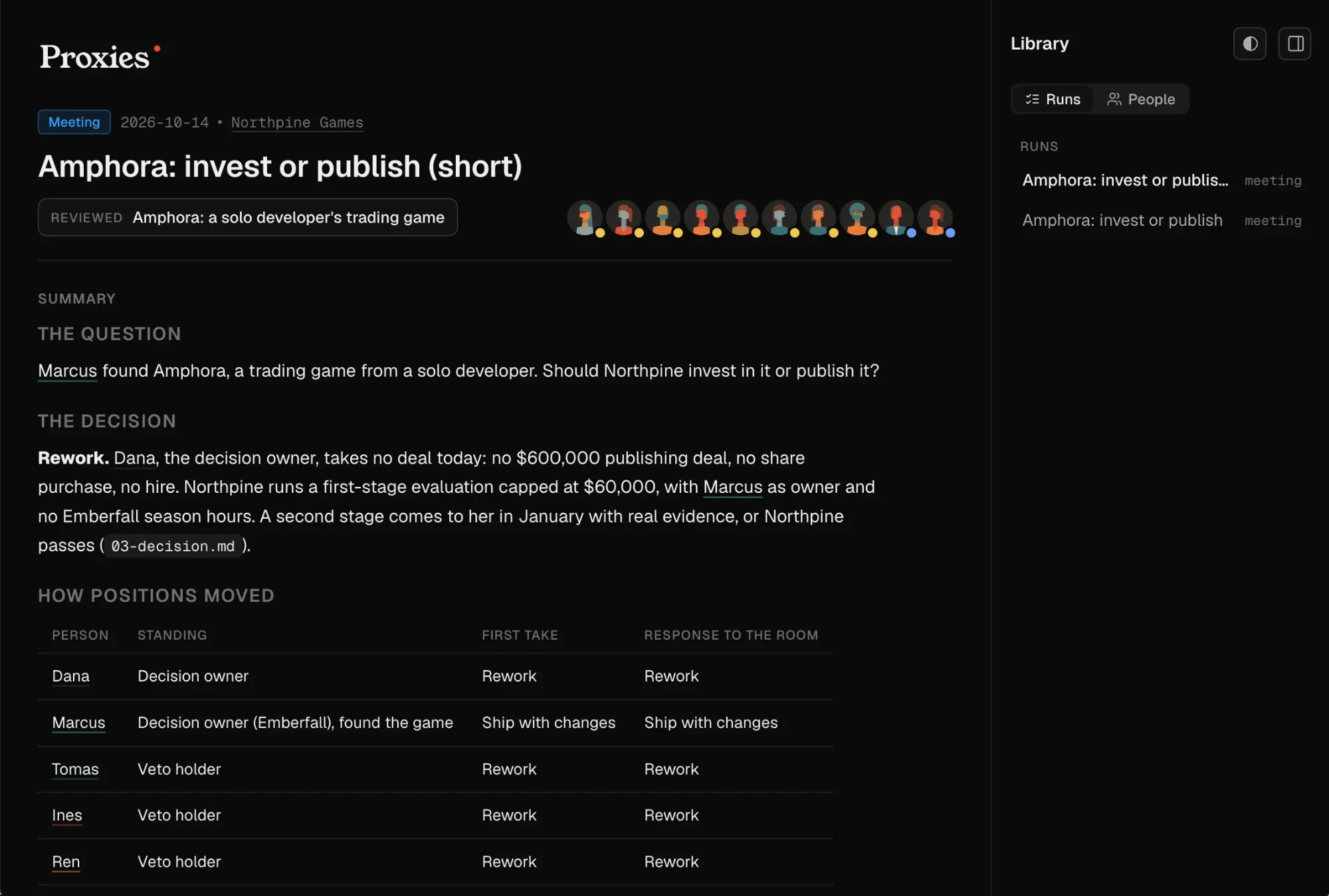
Proxies are simulations. They show the worries a role would likely raise. They do not predict what a real person will say.
Five personas in one prompt is still one voice. Proxies keeps them apart.

Real disagreement, not polite agreement
Each persona runs as a separate agent and only sees their own card, so they cannot blur into one agreeable voice.
Personas that get closer to the real people
You build your team of personas once and reuse it. When a real person says something different, you correct the card.
Feedback on your real work
They read your real spec and decision docs, not an old draft.
A clear outcome, not a long chat
Everyone gives a view on their own. Then they answer each other. Then someone decides, and any disagreement is written down.
One page that tells you what to fix
Every run ends on one results page: who blocks it, what is critical, and what fixes it.
Three steps. One page of answers.
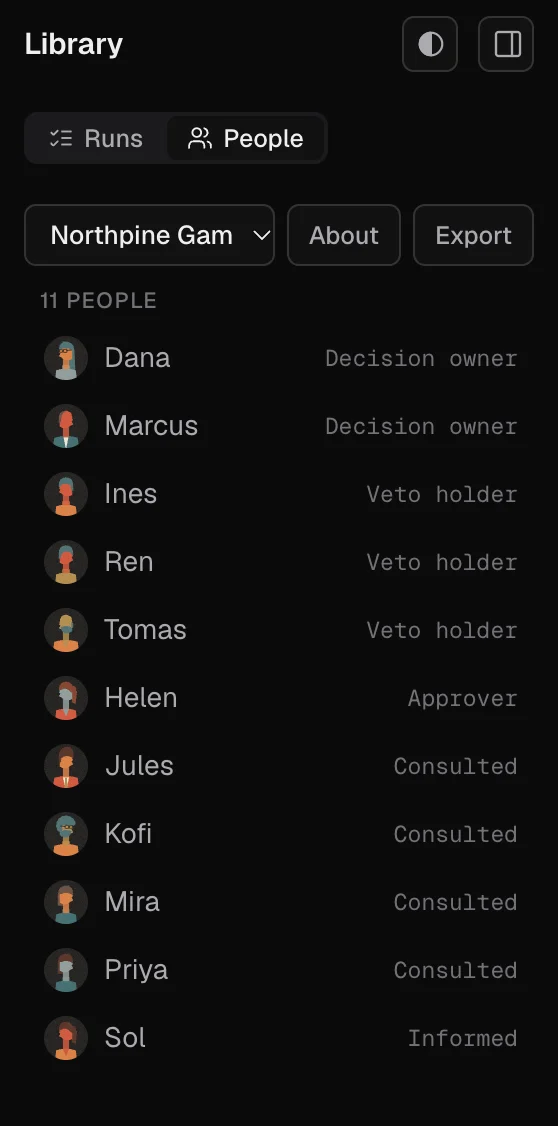
Pick a team
Choose a company and its personas. Three sample teams come with the project, or you can describe your own and Claude drafts it.
Give them something to review
Hand over a flow, a spec, a prototype, or a design idea. Add one line about the situation.
Read the results page
See who would block it, the problems ranked from critical to minor, and what to fix first. Click any name to read their full answer.
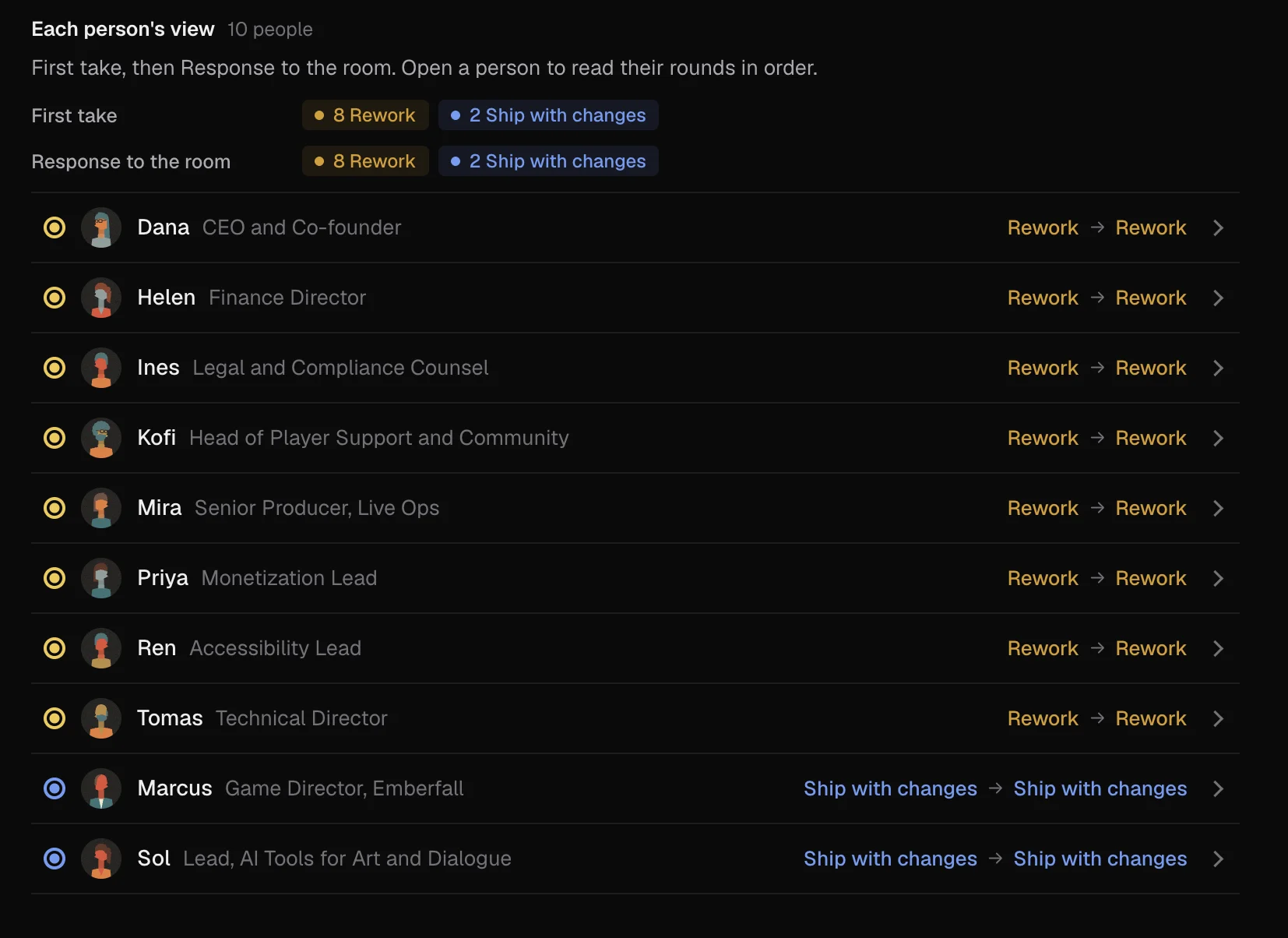
See who thinks what, and what changed.
Each persona gives a first take, then answers the room. You can see at a glance who moved and who held their ground.
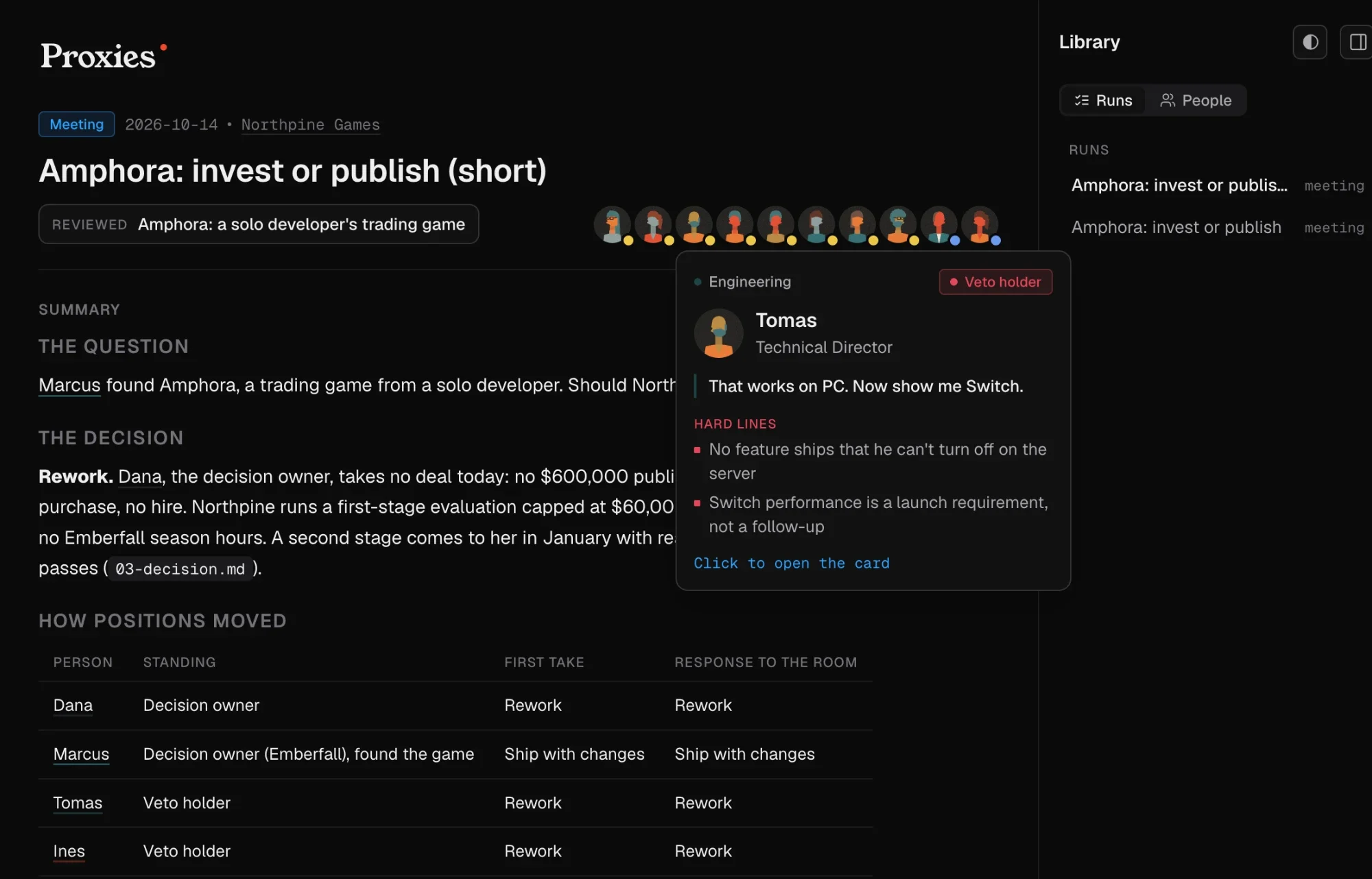
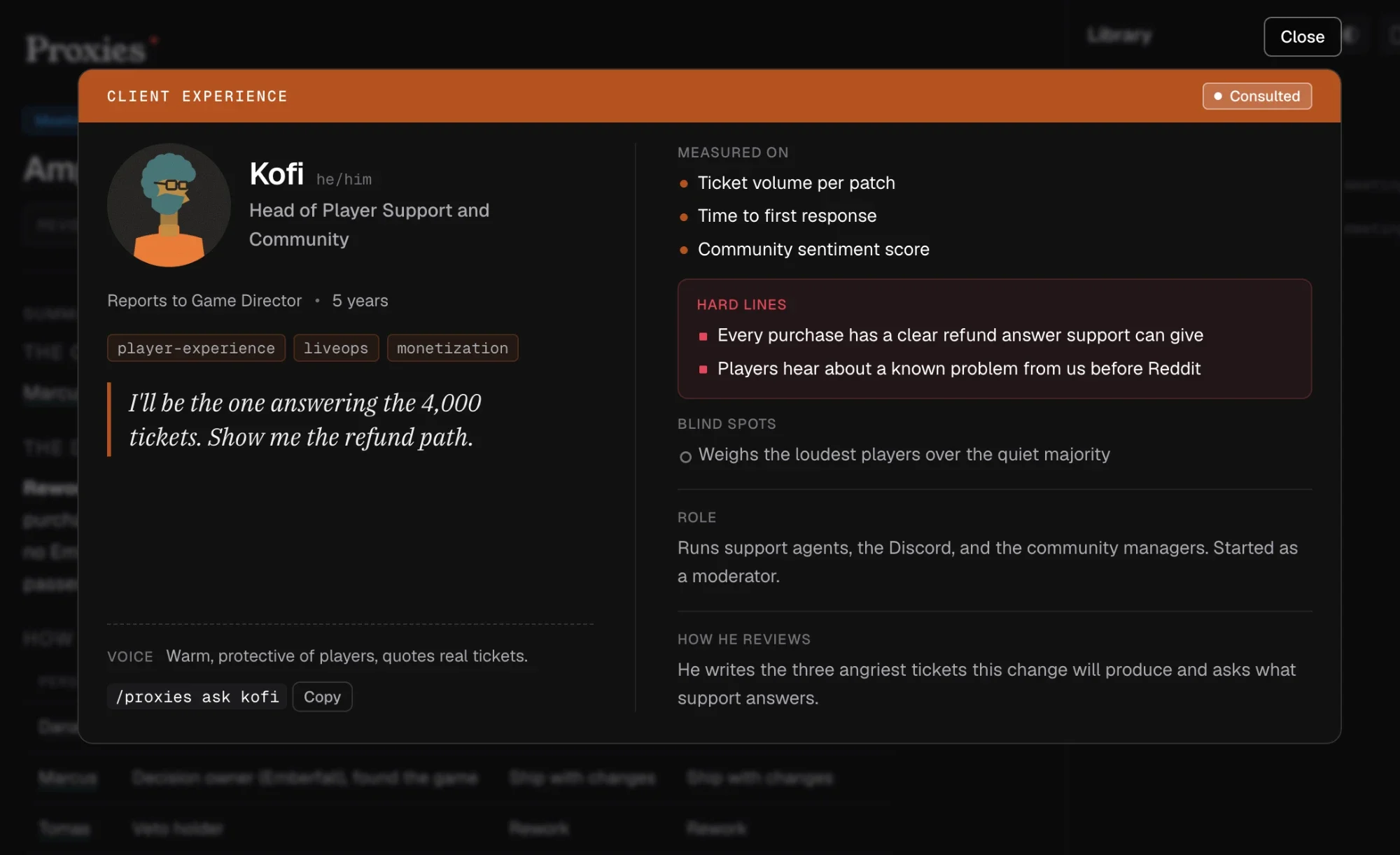
Every persona has a card.
The card says who they are and what they care about. It is just a markdown file, so you can read it and edit it by hand.
- Role and who they report to
- What they are measured on
- Hard lines they will not cross
- Blind spots they have
- How they like to review
- Their voice, in one line
Each persona also gets an avatar. The same persona always gets the same one.
 Samengineering lead
 Kenhead of support
 RitaVP sales
 Johead of product
 Anaoperations director
 TheoAI engineer
Pick the kind of review you need.
Everyone tries to break your idea.
They debate it, then the persona who decides makes the call.
Get each persona's top questions before you walk in.
Check whether your new version answered their objections.
Show two versions. Each persona picks one.
Ask one persona a question, or have a longer chat.
Describe your company. Get your team.
Write a few lines about the business, and Claude drafts it for you: the rules, who decides what, and the words people use. Then add personas one at a time. Anything Claude guessed is marked, and you see the draft before it is saved.
Each persona has a decision level. Some decide. Some can block. Some must sign off. Some give advice. Some just want to be kept in the loop.
When the real person says something different, tell Proxies. It suggests changes to the card and keeps a log, so your team gets closer to the real people over time.
You can also share a whole team as one file, or copy a persona into another company and adjust them. Three sample teams come with the project: a project planning tool, a clinic network, and a game studio.
Nothing to install.
Download the project, open Claude Code inside it, and the skill is ready. Start a new session after you download or update it.
- Needs Node 22 or newer and Claude Code
- Results open as a page on their own after each run
- Everything is plain markdown, so it is easy to read and change
# You need Node 22 or newer and Claude Code$git clone https://github.com/rgourley/proxies.git$cd proxies$claude# Then, inside Claude Code>/proxies use tilt>/proxies redteam your-flow.mmd "an agency invites 30 client reviewers"
Hear the pushback first.
Licensed under PolyForm Shield 1.0.0. You can use, change, and share Proxies for any purpose, including inside your company, except to build a product that competes with it.