I put a deep-sea diver at a bus stop to learn how Z-Image reads a prompt
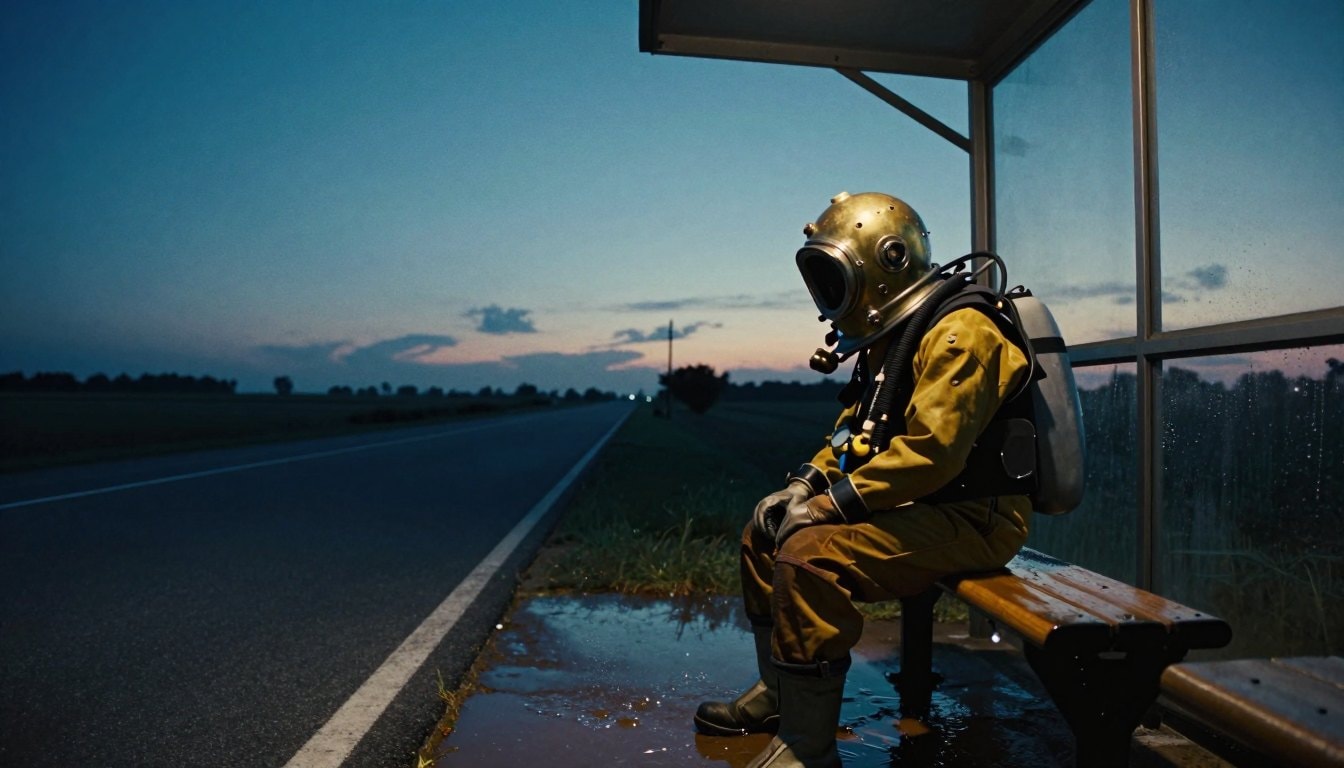
One deep-sea diver, one bus stop, one seed. Each step adds one part of the prompt so you can see exactly what it changes, plus nine shot types to copy and the mistakes that cost me the most time.
I typed "a deep-sea diver at a bus stop" into Z-Image Turbo, and it put the bus stop at the bottom of the ocean.
That's a fair reading of seven words. It's also the problem with most prompts. Z-Image fills every gap you leave with the most common version of the thing, and the most common version of a diver is underwater, in modern scuba gear, lit like an aquarium. Everything I wanted, the brass helmet, the empty country road, the sun going down behind him, had to be written down.
Most Z-Image prompt guides tell you to write four parts: subject, lighting, camera, film. That's right, as far as it goes. What they don't show you is what each part does to the picture, because they paste example prompts without the images that came out. So I built one prompt a piece at a time, on the same seed, and kept every result.
Everything here is Z-Image Turbo at 1344×768, 8 steps, CFG 1, on my RTX 5080. First seed, no fixes. Click any image to see it full size.
One prompt, built in six steps
1. The idea
a deep-sea diver at a bus stop
This is what you get for a short prompt: the model's default. It's not wrong. It just isn't yours.
2. Who, wearing what, where
a deep-sea diver in a dented old brass helmet and canvas suit sitting alone on the bench of a rural bus stop, water dripping onto the road, empty fields all around
He's out of the water, and the helmet is the old brass kind. "Water dripping onto the road" put puddles under the bench, which is the detail that makes it funny. But the light is flat and gray, because I didn't say anything about it.
3. Where the light comes from
a deep-sea diver in a dented old brass helmet and canvas suit sitting alone on the bench of a rural bus stop, water dripping onto the road, empty fields all around, golden hour, the sun low directly behind him, glowing backlight on the brass, long shadows stretching across the road, warm dust in the air
This is the biggest jump of the six. I put light third on purpose. In my earlier tests I added it near the end, and three steps in a row looked the same dull gray. Name where the light comes from, not just the mood. "Nice lighting" gives Z-Image nothing. "The sun low directly behind him" gives it a direction, a color and a shadow.
4. The camera, written first
low angle from the edge of the road, wide 24mm lens, a deep-sea diver in a dented old brass helmet and canvas suit sitting alone on the bench of a rural bus stop, water dripping onto the road, empty fields all around, golden hour, the sun low directly behind him, glowing backlight on the brass, long shadows stretching across the road, warm dust in the air
The camera words go at the front of the prompt. My first version had "low angle" tacked onto the end of a long prompt, and Z-Image ignored it completely. With the angle written first, it took. In my tests, Z-Image paid more attention to what came first.
I also tried a worm's-eye view from the road surface here. It came out the same on every seed: the diver dead center under the shelter roof, flat and symmetrical. A low angle from the edge of the road, with a wide lens, kept the sun and the long road in the frame.
5. Blocking: where he sits and where he looks
low angle from the edge of the road, wide 24mm lens, a deep-sea diver in a dented old brass helmet and canvas suit sitting alone on the bench of a rural bus stop, water dripping onto the road, empty fields all around, seen in profile, the helmet turned down the empty road away from the camera, placed on the right third of the frame with the long road vanishing on the left, golden hour, the sun low directly behind him, glowing backlight on the brass, long shadows stretching across the road, warm dust in the air
This is the step other guides skip. If you don't say where a person looks, Z-Image often has them look at the lens, and that's what makes AI images feel like stock photos. Say which part of the frame they're in, and that they're looking away.
6. The film look
low angle from the edge of the road, wide 24mm lens, a deep-sea diver in a dented old brass helmet and canvas suit sitting alone on the bench of a rural bus stop, water dripping onto the road, empty fields all around, seen in profile, the helmet turned down the empty road away from the camera, placed on the right third of the frame with the long road vanishing on the left, golden hour, the sun low directly behind him, glowing backlight on the brass, long shadows stretching across the road, warm dust in the air, fast tungsten motion picture film, teal shadows and warm orange highlights, film grain
The grade comes last, and it does the least. That surprised me. When my early tests looked fake, I blamed the color. It was almost always the light or the blocking.
Same shot, different light
Light is where I'd spend your words. Same diver, same seed, only the light changed. The full prompts are below the pictures.
Golden hour
wide shot from a low angle, 28mm lens, a deep-sea diver in a dented old brass helmet and canvas suit sitting alone on the bench of a rural bus stop, water dripping onto the road, empty fields all around, the helmet turned down the empty road away from the camera, golden hour, the sun low directly behind him, glowing backlight on the brass, long shadows stretching across the road, fast tungsten motion picture film, teal shadows and warm orange highlights, film grain
Fluorescent tube
wide shot from a low angle, 28mm lens, a deep-sea diver in a dented old brass helmet and canvas suit sitting alone on the bench of a rural bus stop, water dripping onto the road, empty fields all around, the helmet turned down the empty road away from the camera, night, lit only by the bus stop's single flickering fluorescent tube, the fields pitch black, fast tungsten motion picture film, teal shadows and warm orange highlights, film grain
Headlights
wide shot from a low angle, 28mm lens, a deep-sea diver in a dented old brass helmet and canvas suit sitting alone on the bench of a rural bus stop, water dripping onto the road, empty fields all around, the helmet turned down the empty road away from the camera, night, the bright headlights of a car coming down the road straight toward him, long shadows behind him, fast tungsten motion picture film, teal shadows and warm orange highlights, film grain
Blue hour
wide shot from a low angle, 28mm lens, a deep-sea diver in a dented old brass helmet and canvas suit sitting alone on the bench of a rural bus stop, water dripping onto the road, empty fields all around, the helmet turned down the empty road away from the camera, deep blue hour after sunset, the sky still glowing on the horizon, no lights on yet, fast tungsten motion picture film, teal shadows and warm orange highlights, film grain
Each one is a different scene, even though nothing else moved.
Camera angles are less reliable
I'd like to tell you every angle works. It doesn't. Same diver, same seed, camera words first:
The close-up worked. The extreme wide shot only pulled back a little, and the Dutch angle didn't tilt at all. With a lot of detail about the subject in the prompt, Z-Image tends to keep the subject at a comfortable size no matter what you ask. The low angle in step 4 worked because I put it first and kept it simple. If an angle matters, put it first and say it plainly. If it still doesn't land, change the seed before you rewrite the prompt.
Nine shot types to copy
Each block is the complete prompt I used.
macro close-up of the face of a vintage steel dive watch, the black rotating bezel and luminous hands filling the frame, water droplets on the crystal, golden hour light glinting off the polished steel, very shallow focus, 100mm macro lens, 35mm motion picture film, fine grain
close-up of a woman's face in a dark room lit only by the flame of a match she is lifting to a candle, warm light on her cheek and eyes, everything else black, 85mm lens, very shallow focus, 35mm motion picture film, fine grain
For the watch, my first versions cropped the bracelet or added a wrist cut off at the edge of the frame. Going in close on the dial solved both. Look closely at the dial, though. That's not a real brand. More on that below.
extreme wide establishing shot of a lone white lighthouse on a cliff above a stormy sea at blue hour, its beam cutting through rain, waves breaking far below, long telephoto lens, 35mm motion picture film, fine grain
medium two-shot through the windshield of a father and his teenage daughter sitting in silence in a parked pickup truck at night in the rain, lit only by the green dashboard glow, both looking away from each other out their own windows, rain streaks on the glass, 35mm lens, 35mm motion picture film, fine grain
My first two-shot was two old friends laughing in a red convertible on a coast road. It looked exactly like a prescription drug ad. A two-shot needs something between the people. Silence works.
over-the-shoulder shot from behind a painter standing at an easel on a cliff above the sea, her shoulder and brush dark and soft in the foreground, the half-finished painting and the real sunset beyond, 50mm lens, 35mm motion picture film, fine grain
point of view shot looking straight down from the edge of a towering sea cliff, the toes of two worn leather hiking boots at the rocky edge at the bottom of the frame, a dizzying drop of hundreds of feet to the sea far below, the waves soft and hazy in the distance, sea spray mist hanging in the air, seabirds tiny beneath, golden hour, ultra wide lens, 35mm motion picture film, fine grain
top-down overhead shot of a long wooden table set for a summer dinner party in a garden at dusk, candles, bowls of pasta, bread, wine glasses, hands reaching for food, string lights at the edges, 35mm motion picture film, fine grain
wide exterior shot of a 1960s mid-century modern house in the desert at blue hour, seen from across the front garden, the house set back behind cactus, agave and a gravel path, low flat roof with a deep overhang, a rough stone wall, warm lamp light glowing through the glass with only hints of furniture inside, a vintage car parked in the carport, palm trees against the deep blue sky, eye-level camera, 35mm lens, 35mm motion picture film, fine grain
The house took two tries. My first prompt asked for glass walls glowing with lamp light, and Z-Image opened the whole living room up to the camera like a dollhouse. Pushing the house back behind the garden and asking for "only hints of furniture inside" made it look like a real photo of a real house.
wide shot of a grand old library hall, very wide and tall, two stories of wooden shelves with a balcony and rolling ladders, shafts of morning sunlight through high windows with dust in the air, in the middle distance a woman stands beside the shelves on the right, reading an open book in her hands, symmetrical one-point perspective, 35mm motion picture film, fine grain
The mistakes that cost me the most time
Naming film and camera brands
A lot of guides tell you to write "shot on Kodak Portra 400." On Z-Image, brand names can turn into text in the picture. In my film and camera test, it printed "Kodak" on a coffee cup, "Canon" on a shirt, and drew a whole RED cinema camera on the back of a truck.
It doesn't happen every time. This diver came out almost identical both ways:
A diver on an empty road gives it nowhere to print a logo. A kitchen full of cups and cereal boxes does. Describing the film gets you the same look with no risk, so that's what I use.
Writing "no" in the prompt
Z-Image Turbo has no negative prompt. It runs at CFG 1, and at CFG 1 the negative prompt isn't used at all. So people write "no text" or "no people" into the main prompt instead, and it backfires. Naming a thing, even to rule it out, puts it in the picture.
I wrote "no fuel hose or nozzle in the frame" and got this, on all four seeds. What finally worked was moving him to the hood of the car and never mentioning the hose at all. Describe what you want, not what you don't. If you really need a negative prompt, the slower Z-Image base model supports one.
Writing "cinematic"
"Cinematic film still of" got me a woman walking straight at the camera under a gray sky, like a jeans ad. Writing down the actual decisions, how far away the camera is, where the sun is, where the horizon sits, got me a shot someone planned. I tested that across more than 100 movie stills, and "cinematic" lost every time.
Words that imply lettering
Signs, menus, posters, book covers and machine labels almost always come out as garbled fake words. That includes words that only suggest a sign. "24-hour diner" got "24-HOUR" painted on the window. Leave lettering out of the prompt and add any real text afterward.
Some things come with lettering whether you ask or not. Every watch I made had a made-up brand name on the dial, even when the prompt asked for "a clean matte black dial with only luminous hour markers and hands." Z-Image has seen too many watches with logos.
If you need a clean dial, a phone screen or a book cover, plan to fix it after.
The order I use now
[camera: angle and lens], [who, wearing what, doing what, where], [where they sit in the frame and where they look], [where the light comes from], [the film look, described not named]
If you'd rather pick than type, my free ComfyUI workflow has all of this as dropdowns: shot size, angle, lens, placement, where they look, 27 lighting setups and weather. It builds the prompt for you and renders it in eight film looks from one seed.
The diver is still my favorite test. If a prompt can get him out of the ocean and onto the right bench in the right light, it can handle most things.